
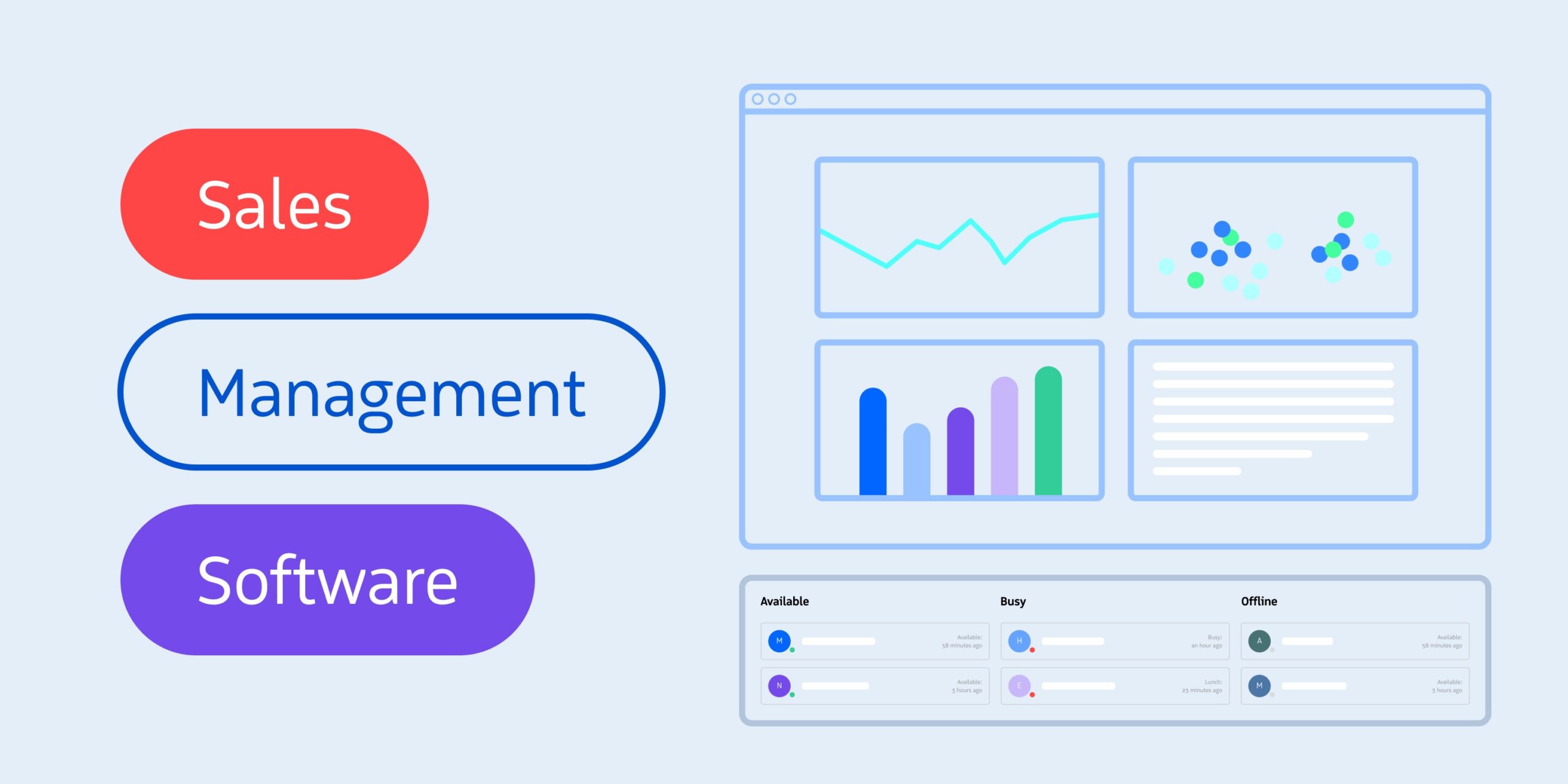
What is Sales Management Software?
The definition of sales management software refers to systems that enable sales managers to gain increased insight into key performance indicators across their organization. Sales management software might enable managers to see, in real time, which reps are on pace to meet goals. Sales management systems might also track key call metrics like average hold time and calls-per-day-by-rep so that managers can optimize their sales process for maximum revenue generation. While some sales management software solutions are stand-alone, other sales management solutions integrate with Salesforce and other systems of record, providing additional dashboards and enhanced reporting capabilities.
What Is Sales Management in Simple Terms?
Sales management is the process of leading a sales team toward consistent, predictable revenue. It covers everything a sales leader does to help their team perform: setting targets, hiring and developing reps, defining the sales process, tracking pipeline health, and coaching individuals to improve over time.
At its core, sales management is about translating company revenue goals into day-to-day activity. A sales manager decides which markets to pursue, how to structure the team, what metrics to hold reps accountable to, and what support to provide when performance falls short. They are the bridge between strategy and execution.
Good sales management does not just respond to problems after they show up in the numbers. It creates the conditions where problems surface early, get addressed quickly, and do not repeat. That requires visibility into what reps are doing, clarity on what good performance looks like, and a consistent coaching process that develops capability across the whole team rather than just the top performers.
Metrics to Track
With sales management software, managers can track critical metrics like average call duration, hold times, and calls-per-day-by-rep. This level of granularity allows leaders to identify trends, pinpoint inefficiencies, and implement strategies that maximize productivity. For example, if one rep consistently struggles with call volume, sales management software can flag this, enabling timely coaching and support to improve performance.
CRM Software
Modern sales management tools often integrate seamlessly with CRM systems like Salesforce, adding powerful reporting and visualization capabilities. These integrations allow managers to pull data from multiple sources into a single dashboard, simplifying decision-making and providing a holistic view of the sales organization. From pipeline health to individual rep performance, everything is available at a glance, making it easier to prioritize coaching efforts and align team activities with business goals.
Beyond tracking and reporting, sales management software also plays a vital role in process optimization. Managers can use these systems to analyze which activities drive the best results, automate administrative tasks, and create playbooks that replicate top-performing behaviors across the team. By standardizing and scaling best practices, sales management software ensures consistency and helps teams win more deals.
Whether you’re leading a small inside sales team or managing a global enterprise, these systems provide the insights, automation, and tools needed to stay ahead of the competition and drive predictable revenue growth.
Increasingly, teams are also adopting revenue management software to gain deeper insights into deal velocity, quota attainment, and forecasting accuracy, giving leaders the visibility and levers they need to drive strategic growth.
What Is the Difference Between CRM and Sales Management Software?
CRM and sales management software are related but serve different purposes. Understanding the distinction helps sales leaders choose the right tools and avoid expecting one system to do the job of the other.
A CRM, or Customer Relationship Management system, is primarily a database. Its core function is to store and organize information about contacts, accounts, opportunities, and interactions. Salesforce is the most widely used example. A CRM tracks what has happened: which calls were logged, which emails were sent, where each deal sits in the pipeline, and what the historical relationship with a customer looks like. It is the system of record for all customer-facing activity.
Sales management software, by contrast, is built around what managers need to do with that information. Where a CRM stores data, sales management tools surface insights, flag risks, and enable action. A sales management platform might analyze CRM data to show which reps are falling behind on activity metrics, which deals have gone stale, or which talk tracks are converting at the highest rate. It turns raw data into coaching opportunities and operational decisions.
In practice, the two categories increasingly overlap. Many sales management tools are built on top of or deeply integrated with Salesforce, pulling CRM data in real time to power dashboards, alerts, and workflow automation. The distinction worth keeping in mind is that the CRM is where data lives, and sales management software is how leaders act on it. Organizations that rely on CRM reporting alone often find themselves reacting to problems after the fact. Sales management tools are designed to surface those problems early enough to do something about them.