
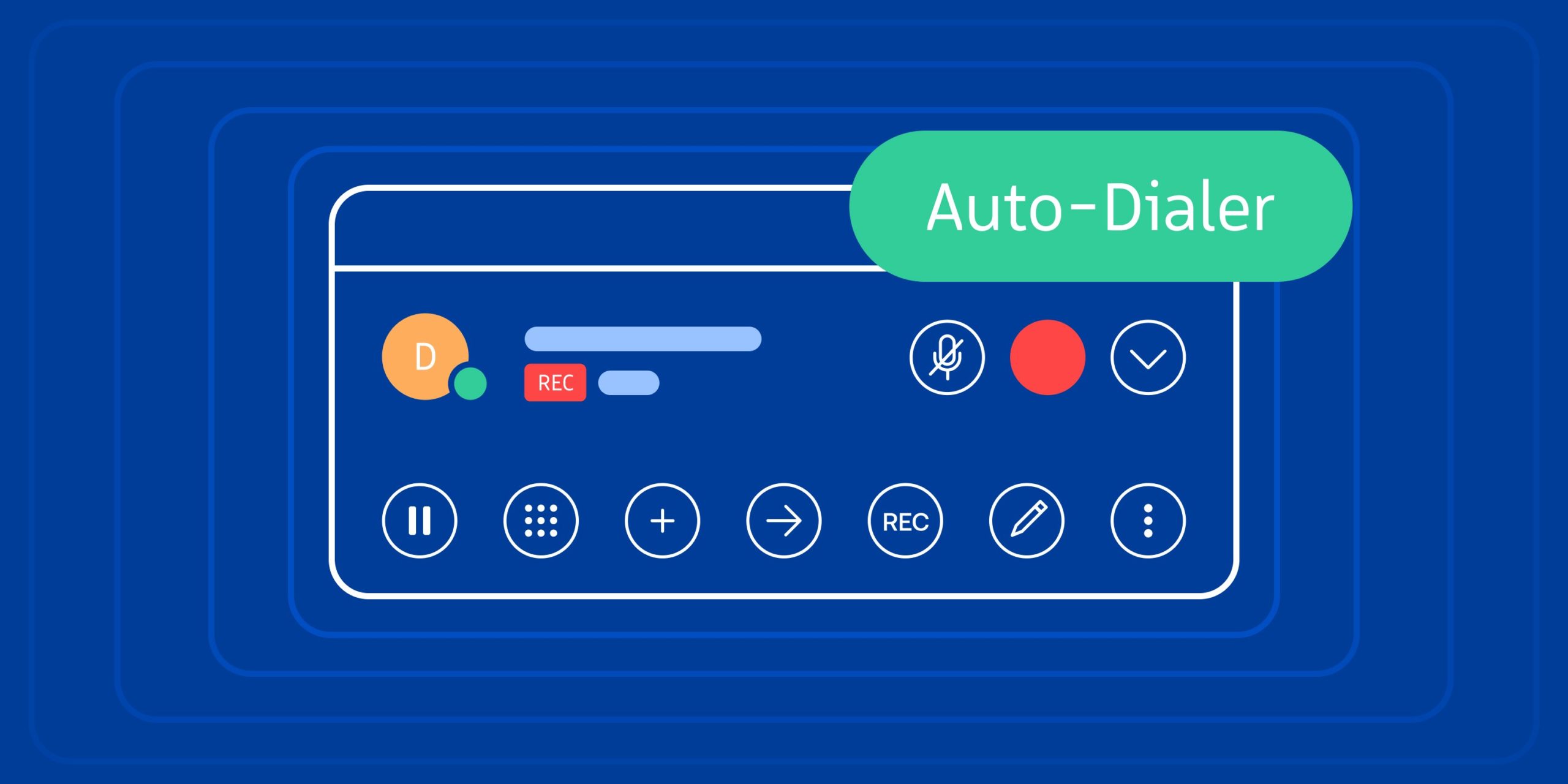
What is an Auto Dialer?
The definition of automatic dialers (or auto dialer software) describes a system that can automate and expedite the dialing of phone numbers. While auto-dialers began as hardware solutions, auto-dialing software is now far more common. Auto-dialers are sometimes used as a blanket term for dialers that may include predictive dialers, hosted dialers, intelligent dialers, and robo-dialers.
An auto dialer is a calling system that automatically dials phone numbers from a predefined contact list without requiring manual input from a sales or support representative. When a call is answered, the system either connects the call to a live agent or plays a pre-recorded message, depending on how the auto dialer is configured. Auto dialers are commonly used in outbound sales, customer service, appointment reminders, collections, political campaigns, and large-scale outreach environments where efficiency and call volume are priorities.
How an Auto Dialer Works
While functionality varies by platform, most auto dialers follow a structured workflow:
- Contact lists are uploaded or synced from a CRM or database.
- The dialer automatically begins placing outbound calls based on configured logic.
- The system detects whether a call is answered by a live person, goes to voicemail, or fails to connect.
- Live calls are routed to available agents or handled according to campaign rules.
- Call outcomes are logged automatically.
More advanced auto dialers may include voicemail detection technology, local presence dialing, lead prioritization logic, real-time performance dashboards, automated call recording, and compliance pacing controls.
The sophistication of the dialing logic typically determines whether the system operates as a predictive, power, progressive, or preview dialer.
What Features Should an Auto Dialer Have?
The right auto dialer does more than place calls automatically. It should reduce administrative burden, support compliance, integrate with your existing systems, and give managers visibility into performance. Here are the features that matter most.
CRM Integration
An auto dialer that connects natively with your CRM eliminates the need for reps to manually log calls, update records, or switch between systems. It should pull contact data automatically before each call and push outcomes, notes, and dispositions back to the CRM in real time. For Salesforce users, a native integration that writes directly to Salesforce objects without middleware is the highest-value option.
Voicemail Drop
Reps should be able to leave a pre-recorded voicemail with a single click rather than recording a new message on every unanswered call. This saves significant time in high-volume calling sessions and ensures consistent messaging across every attempt.
Local Presence Dialing
Displaying a phone number with the same area code as the prospect increases answer rates significantly. Local presence dialing should work automatically based on the prospect’s location without requiring reps to manage multiple numbers manually.
Call Recording and Monitoring
Call recording enables quality assurance, compliance documentation, and coaching. Managers should be able to review recordings, flag calls for follow-up, and use conversation data to identify patterns across the team. Platforms that combine recording with AI-powered transcription and conversation intelligence deliver substantially more value than recording alone.
Compliance Controls
Any auto dialer used for outbound calling needs built-in compliance safeguards. These include DNC list scrubbing, time zone restrictions that prevent calls outside permitted hours, abandonment rate monitoring, and consent-based dialing workflows. These are not optional features — they are requirements for legal operation in most jurisdictions.
Call Disposition Tracking
Reps should be able to quickly categorize the outcome of each call — connected, voicemail, no answer, not interested, demo scheduled — and have those dispositions automatically logged. This feeds reporting, follow-up workflows, and list management without adding manual steps.
Real-Time Dashboards
Managers need visibility into what is happening across the team during active dialing sessions. Real-time dashboards should show call volume, connect rates, talk time, and individual rep activity so leaders can coach proactively rather than reviewing results after the fact.
Is an Auto Dialer the Same as a Robocall?
No, but the two are related. An auto dialer is the technology — a system that automatically places outbound calls from a list. A robocall is a specific type of call placed by an auto dialer that delivers a pre-recorded message to the recipient rather than connecting them to a live agent.
All robocalls use an auto dialer, but not all auto-dialed calls are robocalls. When an auto dialer places a call and connects the answered call to a live sales rep, that is not a robocall — it is a standard outbound call that was initiated automatically. When the same system places a call and plays a recorded message instead of connecting a person, that is a robocall.
The distinction matters both legally and practically. Robocalls face stricter regulatory requirements under the TCPA and FCC rules than auto-dialed calls that connect to live agents. Many legitimate businesses use auto dialers for sales outreach without ever placing a robocall, because their systems always connect answered calls to available representatives.
The negative perception of robocalls comes primarily from fraudulent or spam operations that use auto dialers to blast prerecorded messages at scale. Legitimate outbound sales organizations use auto dialers differently and should not be conflated with those operations.
Are Auto Dialers Illegal in the US?
Auto dialers are not illegal in the United States, but their use is heavily regulated. The primary regulatory framework is the Telephone Consumer Protection Act (TCPA), enforced by the Federal Communications Commission (FCC).
What the TCPA Restricts
The TCPA places specific restrictions on the use of automatic telephone dialing systems when contacting mobile phones. Calling a mobile number using an auto dialer for marketing purposes generally requires prior express written consent from the recipient. Calls made without that consent can result in statutory damages of up to $500 per call for negligent violations and up to $1,500 per call for willful violations.
For calls to residential landlines, the rules are somewhat different, and B2B calls to business phone numbers face fewer restrictions than consumer-facing calls. However, all auto-dialed calls must comply with Do Not Call Registry requirements and time-of-day restrictions regardless of the number type.
The ATDS Definition Question
A significant legal question surrounds which systems qualify as an automatic telephone dialing system under the TCPA. The Supreme Court’s 2021 ruling in Facebook v. Duguid narrowed the federal definition, holding that an ATDS must use a random or sequential number generator to store or produce numbers. Systems that dial from a pre-loaded contact list without using a random number generator may not meet this definition. However, state laws in California, Florida, and other states apply broader definitions, so compliance requirements vary by jurisdiction.
Practical Guidance
Auto dialers are legal and widely used across sales, support, and marketing organizations. The key requirements are obtaining proper consent before calling mobile numbers for marketing purposes, scrubbing lists against the Do Not Call Registry, respecting time-of-day restrictions, and not placing calls that result in abandoned connections at a rate that violates FCC thresholds.
Note: This is general informational guidance and not legal advice. Organizations should consult legal counsel to confirm their specific dialing practices comply with applicable federal and state laws.
Can Debt Collectors Use Auto Dialers?
Yes, debt collectors can use auto dialers, but their use is subject to significant regulation under both the TCPA and the Fair Debt Collection Practices Act (FDCPA).
Under the TCPA, debt collectors calling mobile phones using an auto dialer generally need prior express consent from the debtor. This consent is often established when the debtor originally provided their mobile number at the time of the transaction that created the debt. If the debtor revokes consent, calls to their mobile number using an auto dialer must stop.
The FDCPA adds additional layers of restriction. Debt collectors cannot call at inconvenient times, which the FDCPA defines as before 8 a.m. or after 9 p.m. in the debtor’s time zone. They cannot call a debtor’s workplace if they know the employer prohibits such calls. And they must stop calling if the debtor requests in writing that contact cease.
The Consumer Financial Protection Bureau (CFPB) has also issued rules under Regulation F that address digital and telephone communication practices for debt collectors, including how frequently calls can be placed and what constitutes harassment.
In practice, debt collection is one of the more heavily scrutinized use cases for auto dialers precisely because violations can be financially severe and class action lawsuits are common. Debt collection organizations using auto dialers need robust consent management, call frequency controls, and DNC compliance built into their dialing workflow.
Note: This is general informational guidance and not legal advice. Debt collection organizations should consult legal counsel regarding their specific compliance obligations.
What Are the Common Problems with Auto Dialers?
Auto dialers solve real productivity problems, but they also introduce operational and compliance challenges that teams need to manage proactively.
Call Abandonment
Predictive dialers can dial more numbers than available agents can handle, resulting in calls that connect but have no agent ready to speak. The caller hears silence or a hang-up, which is both a poor experience and a compliance risk. The FCC limits abandonment rates to 3% of answered calls in a 30-day period. Teams that do not monitor abandonment actively risk violating this threshold.
Spam Labeling
High-volume outbound calling from the same numbers can trigger carrier spam detection algorithms, causing calls to be labeled as “Spam Risk” or “Scam Likely” before the prospect even answers. This can significantly reduce answer rates even when all calls are legitimate. Maintaining healthy calling patterns, rotating numbers, and ensuring STIR/SHAKEN authentication helps manage this risk.
Compliance Exposure
Without proper DNC scrubbing, consent management, and time-of-day controls, auto dialers create significant legal exposure. Because violations multiply at the scale that auto dialers operate, even a small configuration error can result in thousands of non-compliant calls before it is detected.
Poor CRM Data Quality
Auto dialers are only as effective as the contact lists they run on. Outdated, duplicate, or inaccurate data wastes call attempts, increases the chance of contacting the wrong person, and degrades the metrics used to evaluate campaign performance. Teams that do not maintain list hygiene see diminishing returns from their dialing investment over time.
Rep Adoption and Over-Automation
Some reps resist auto dialers because the pace feels too aggressive or because the tool requires them to change established workflows. Predictive dialers in particular can create stress if agents feel they have no control over when calls begin. Choosing a dialer mode that matches the team’s sales motion — power or progressive for consultative sellers, predictive for high-volume outreach — reduces friction and improves adoption.
Integration Gaps
Auto dialers that do not integrate deeply with the CRM create data silos. If call outcomes, notes, and dispositions do not flow automatically into the CRM, reps fill the gap with manual entry — which defeats one of the primary purposes of automation and degrades the data quality the team relies on for forecasting and coaching.
How Much Does an Auto Dialer Cost?
Auto dialer pricing varies widely based on the type of dialer, the depth of CRM integration, the features included, and the number of users. Most vendors quote based on team size and contract terms rather than publishing prices publicly.
Entry-Level Options
Basic auto dialer tools with minimal CRM integration and standard features typically start in the range of $30 to $80 per user per month. These are often suitable for small teams with straightforward outbound calling needs and limited reporting requirements.
Mid-Range Platforms
Platforms with stronger CRM integration, voicemail drop, local presence dialing, call recording, and basic analytics typically range from $80 to $150 per user per month. These are the most common options for growing inside sales teams and SDR organizations.
Enterprise and AI-Powered Platforms
Platforms that include native Salesforce integration, AI-powered conversation intelligence, real-time coaching, automated call summaries, and advanced reporting typically range from $150 to $300 or more per user per month. Revenue.io falls in this category. The higher cost reflects both deeper technical integration and the coaching and intelligence layer that drives rep performance improvement beyond just call volume.
Total Cost of Ownership
Beyond the per-seat license, factor in implementation, onboarding, and any required platform add-ons. Some auto dialers require additional Salesforce licensing such as Service Cloud Voice, which adds significant cost for Salesforce users. Native Salesforce dialers like Revenue.io do not require that additional licensing layer, which can meaningfully change the total cost comparison at scale.
For most outbound sales teams, the ROI calculation is driven by the increase in live conversations per rep per day. A dialer that doubles or triples conversation volume at a modest per-seat cost typically pays for itself within the first quarter.
Types of Auto Dialers
The term auto dialer is often used broadly to describe multiple dialing technologies. Understanding the distinctions is important when selecting the right solution.
Predictive Dialer
A predictive dialer uses algorithms to dial multiple numbers simultaneously based on projected agent availability. Its goal is to maximize agent talk time and minimize idle time. Best suited for high-volume call centers where efficiency outweighs personalization.
Power Dialer
A power dialer automatically dials one number at a time and connects reps only when someone answers. It maintains higher control while still eliminating manual dialing. Common in B2B sales environments and SDR teams.
Progressive Dialer
A progressive dialer automatically calls the next contact only when an agent becomes available. It does not dial ahead aggressively like predictive systems. Often preferred in regulated industries.
Preview Dialer
A preview dialer presents contact information to the rep before placing the call. The rep manually initiates the call after reviewing context. Ideal for enterprise or consultative sales models.
In practice, many modern platforms offer multiple dialing modes within a single system.
Auto Dialer vs Manual Dialing
Manual dialing requires representatives to enter phone numbers individually, wait through unanswered calls, leave voicemails manually, log activity by hand, and switch between systems. These small inefficiencies compound throughout the day and significantly reduce conversation volume.
An auto dialer automates number progression, reduces idle time, logs activity automatically, and standardizes workflows across teams.
While manual dialing may work for low-volume outreach or highly strategic one-off calls, it becomes unsustainable as outbound scale increases.
Benefits of Using an Auto Dialer
Auto dialers increase productivity and operational visibility across outbound teams.
Increased Call Volume
Automation allows reps to place significantly more calls per hour compared to manual workflows.
Reduced Administrative Work
Automatic call logging, voicemail drop, and CRM sync reduce repetitive tasks.
Improved Connect Rates
Features like local presence dialing increase the likelihood that prospects answer.
Better Data Accuracy
Call outcomes and timestamps are captured automatically, improving CRM hygiene and forecasting reliability.
Scalable Outreach
Auto dialers allow organizations to expand outbound programs without proportionally increasing administrative burden.
Compliance and Regulatory Considerations
Because auto dialers automate call placement, compliance is a critical consideration. Organizations must adhere to regulations such as the Telephone Consumer Protection Act in the United States, the General Data Protection Regulation in the European Union, and national and regional Do Not Call requirements.
Some dialing systems, particularly predictive dialers, can increase abandonment risk if not configured correctly.
Modern auto dialers often include call pacing controls, abandonment rate limits, DNC list management, time zone protections, and consent-based dialing workflows. Compliance ultimately depends on responsible implementation and monitoring.
When Should You Use an Auto Dialer?
An auto dialer is appropriate when your team conducts structured outbound outreach, when reps spend excessive time dialing manually, when high call volume is required, when administrative overhead limits productivity, and when CRM accuracy and reporting visibility matter.
Auto dialers are particularly effective for SDR teams, inside sales, collections, and outbound customer engagement programs. For complex B2B environments, selecting the right dialing mode within the broader auto dialer category is often more important than the automation itself.
Conclusion
An auto dialer automates outbound calling to increase efficiency, improve data visibility, and support scalable outreach. By removing manual dialing and reducing idle time, it enables teams to focus on live conversations rather than repetitive tasks.
Not all auto dialers are equal. The right system depends on your sales motion, compliance requirements, personalization needs, and operational goals.
For modern revenue teams, the best auto dialer combines automation with CRM integration, intelligent prioritization, and performance visibility — transforming outbound activity into measurable pipeline impact.
Ready to Upgrade Your Outbound Strategy?
Not all auto dialers are built for modern revenue teams.
The RingDNA Dialer for Salesforce by Revenue.io combines intelligent predictive dialing with native CRM integration, real-time call logging, AI-powered conversation insights, and workflow automation designed for B2B sales environments.