

Best Time to Cold Call B2B Prospects: Data & Time Zones
The best time to cold call B2B prospects is the time that produces useful conversations in your particular market. There is no single hour that applies to every role, region, and buying situation. Start with reasonable windows in the prospect’s local working day, then compare results using consistent definitions.
Treat late-morning and mid-afternoon windows as hypotheses, not proven winners. For example, test 9–11 a.m. against 3–5 p.m. in the buyer’s local time. A shift-based operational role may need a different schedule from a desk-based buyer. Account for local working patterns and your organization’s approved contact rules.
Build a calling-time test you can interpret
- Define the audience. Keep role, market, account fit, lead source, and list quality comparable. Separate inbound response from cold outbound outreach.
- Set the time zone. Use verified location information where available. A phone area code alone is not reliable evidence of where someone works.
- Distribute comparable accounts. Rotate reps and weekdays across the windows. Avoid giving all the strongest accounts to one window.
- Keep the message consistent. Changes to the offer or opening can affect results independently of timing.
- Record attempts and outcomes. Distinguish live answers, relevant conversations, meetings booked, meetings held, and accepted opportunities.
- Review a sufficient period. A few answers on one afternoon do not establish a pattern. Track sample size and variability before reallocating the whole team.
A worked example: more answers do not always mean more meetings
The following numbers are illustrative, not Revenue.io performance data.
| Test window | Attempts | Live answers | Meetings booked |
|---|---|---|---|
| Morning | 500 | 50 (10%) | 5 (1% of attempts) |
| Afternoon | 500 | 60 (12%) | 4 (0.8% of attempts) |
The afternoon window has a higher answer rate, but the morning window has more booked meetings in this example. Neither result establishes a reliable winner by itself. Review meeting quality, meetings held, unique people contacted, repeated attempts, and whether the account mix was comparable. Use the same denominator whenever you report a rate.
What to log in Salesforce
Capture the attempt timestamp and time zone, account and contact, rep, campaign or list, disposition, and next action. Keep “no answer,” “wrong person,” “relevant conversation,” and “meeting booked” distinct. If dispositions are inconsistent, a timing report can reflect reporting habits rather than buyer availability.
Review outcomes by account and person as well as attempt. Repeatedly calling a small set of people can inflate activity totals without expanding coverage. Pair timing with a relevant reason to call and a clear stop rule. Use the outbound sales workflow and sales playbook template to define those rules.
How to use historical calling-time charts
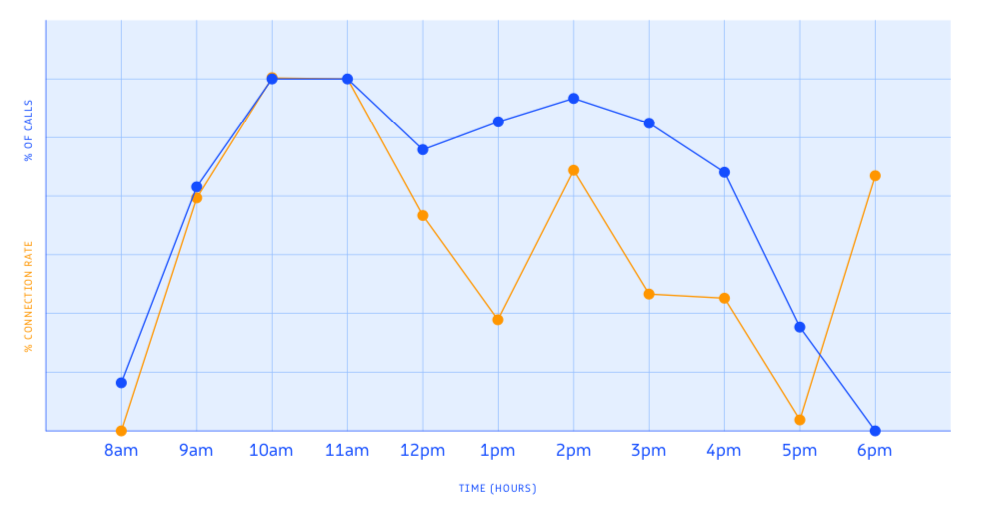
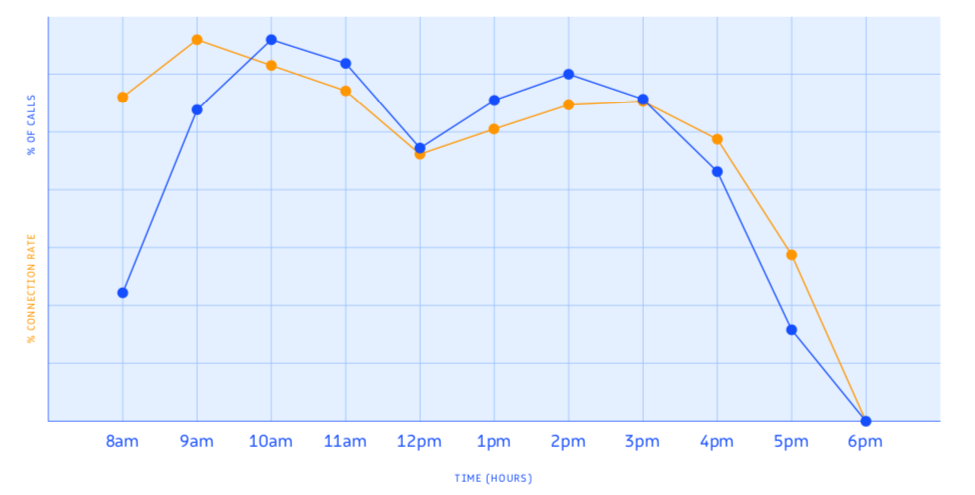
The charts below are historical Revenue.io observations published in 2020. They can suggest questions to test; they do not establish the best calling hour for your team today. Differences in buyers, markets, and collection methods limit direct comparisons.
Separate cold-call scheduling from inbound response
A buyer who requests a demo has already asked for help. Do not delay that response merely to reach a supposed peak cold-calling hour. Measure lead response time separately, with a defined owner and staffed-hours policy.
Make the results actionable
If a window consistently produces better qualified conversations across comparable cohorts, shift part of the schedule and continue monitoring. If results differ by role or region, use separate schedules instead of one global rule. Review deteriorating list quality before blaming the hour.
A power dialer can reduce manual dialing work, but call volume alone does not tell you whether the schedule is effective. Bring a real calling workflow and outcome report to your evaluation.
For a Salesforce calling team, review Revenue.io’s Salesforce dialer workflow. Bring your calling-time test and outcome report to a Salesforce calling demo, and compare dialing and coaching plans against the workflow you want to implement.