
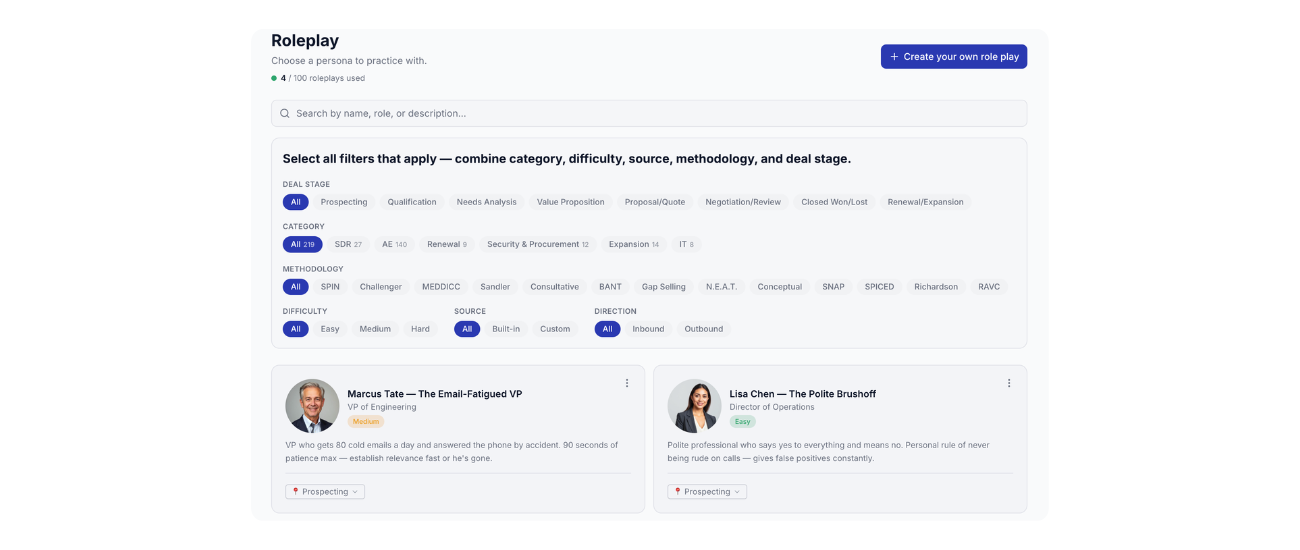
4 AI Sales Roleplay Platforms: Features & Evaluation Tests
AI sales roleplay software lets reps practice with simulated buyers and receive feedback before a real customer conversation. The right platform should reproduce your selling situation, assess the behaviors you care about, and help the rep improve on the next attempt. A believable voice alone is not enough.
This guide compares four evaluation starting points—Revenue Roleplay, Hyperbound, Yoodli, and Mindtickle—and provides a demo script, pilot plan, and purchasing checklist for B2B teams. For choosing between AI, manager, and peer practice, see our separate roleplay format comparison.
Publisher disclosure: Revenue.io publishes this guide and is included. The comparisons describe documented product emphasis, not an independent ranking or hands-on benchmark. Primary sources checked October 7, 2026. Confirm capabilities, packaging, languages, and availability with each provider.
Which AI sales roleplay platform should you evaluate?
Start with your program rather than a universal “best” label. A B2B SaaS team practicing methodology-led discovery has different needs from an organization certifying partner presentations or standardizing communication across several departments.
| Platform | Documented emphasis | First thing to demonstrate |
|---|---|---|
| Revenue Roleplay | B2B SaaS voice practice, methodology-based scenarios, scoring, and debriefs. | Run a discovery scenario in your methodology and inspect the specific behavior behind the feedback. |
| Hyperbound | AI buyers and roleplays configured around a sales process. | Change a buyer objection and check how the conversation and scoring respond. |
| Yoodli | AI roleplay and communication coaching across enablement use cases. | Use your discovery criteria and verify that buyer understanding matters alongside delivery. |
| Mindtickle | Roleplay within a broader revenue enablement environment. | Assign practice around a skill gap and inspect the learner and manager workflow. |
The list is not exhaustive. Use it to establish a shortlist whose vendors can demonstrate your required motion, access controls, and program administration.
1. Revenue Roleplay: methodology-led B2B SaaS practice
Revenue Roleplay documents voice practice with buyer personas, scenario generation, methodology scoring, debriefs, and team coaching insights. Its stated focus is B2B SaaS selling. Evaluate it when you want reps to practice how they conduct a conversation, not simply recite an approved pitch.
Demo test: provide a sanitized deal brief and your discovery criteria. Ask the simulated buyer to resist an early pricing discussion. Inspect whether the debrief identifies the question the rep missed and gives them a useful behavior to repeat. Check the current manager, recording, and access workflow.
The product page links to a self-serve start at Revenue Roleplay. Confirm current trial and plan terms there. Do not assume roleplay sessions automatically write scores to Salesforce or that a Revenue.io platform package includes the separate roleplay offering; verify those commercial and integration details.
2. Hyperbound: practice built around your buyer and process
Hyperbound Practice describes roleplay with AI buyers and coaching for sales conversations. Include it when comparing a practice workflow configured around your personas, objections, and process.
Demo test: run the same scenario twice, changing how the rep explores the buyer’s concern. Inspect the resulting feedback and ask how administrators update the scenario. If related real-call or live-coaching products are part of the proposal, evaluate them separately rather than assuming the roleplay package contains them.
3. Yoodli: communication practice and sales training
Yoodli’s sales-training offering uses AI roleplay for sales conversations and feedback. Its broader platform addresses communication and enablement beyond sales, which may matter when several departments share a training program.
Demo test: ask the platform to assess a discovery call in which a fluent rep misses the buyer’s problem. Determine whether your configured evaluation can separate delivery quality from selling quality. Check how sales-specific criteria, team reporting, and program access are administered.
4. Mindtickle: roleplay within revenue enablement
Mindtickle AI Sales Role Play documents simulated selling scenarios, feedback, and program reporting within its enablement platform. Include it when roleplay needs to connect with a broader readiness and training program.
Demo test: demonstrate how a manager identifies a skill gap, assigns a relevant practice activity, and reviews the resulting evidence. Verify which roleplay, training, and analysis components are included and how the program supports your required languages or presentation formats.
A demo script that exposes shallow roleplay
Give every shortlisted vendor the same brief. The example below is fictional and intended for testing; use approved, sanitized material rather than confidential buyer information.
A RevOps director is considering a change to the sales workflow. Managers disagree about activity quality, and the buyer is concerned about implementation effort. They already have an incumbent tool. The rep’s goal is to understand the problem and agree a useful next step, not force a purchase commitment.
- Make the buyer initially vague. “Our reporting could be better.” See whether the persona provides detail only after a relevant follow-up.
- Introduce an objection. “We cannot disrupt the team this quarter.” Check whether the buyer responds to the rep’s reasoning rather than a memorized phrase.
- Have the rep make an unsupported claim. Use an obviously fictional promise in a test scenario. Inspect whether the feedback notices the issue; do not assume automated review catches every error.
- End without a mutual next step. Determine whether the debrief distinguishes a polite goodbye from an agreed action.
- Repeat the weakest part. Inspect whether the rep can practice the target behavior and understand what changed.
Review the recording or transcript where available. A high score with no inspectable rationale is hard for a manager to coach from. Use a human reviewer to compare the feedback with what actually happened.
What to include in your evaluation scorecard
- Scenario fit: buyer role, sales motion, objection, product context, and difficulty.
- Methodology fit: criteria that reflect your process and call purpose.
- Feedback quality: a relevant observation and a concrete improvement to practice.
- Repeatability: a way to revisit the skill while avoiding a memorized script.
- Manager workflow: assignment, review, disagreement handling, and progress visibility.
- Enterprise requirements: access, identity, retention, permitted data use, and administration.
- Commercial fit: licensed roles, usage limits, implementation, optional features, and renewal terms.
Make mandatory requirements pass/fail. Score the remaining criteria on a shared rubric and retain the demonstration evidence. An appealing persona should not compensate for a failed required language or inaccessible manager report.
A narrow pilot for an enterprise team
Choose one skill, such as discovering business impact, and one representative group. Before practice, have a manager review a relevant simulation or approved real call with the same rubric. Assign practice, inspect feedback, and repeat the assessment using a different scenario.
Track active participation, completed practice, review time, and improvement on the selected behavior. Check whether the behavior also appears in a sample of real conversations when those recordings are available and permitted. Simulation scores alone do not establish shorter ramp time, higher win rates, or revenue impact.
For scenario material, use our sales roleplay scenario library. For discovery evidence, adapt the AI discovery-call scorecard template. Keep the simulated buyer’s answers separate from facts about an actual opportunity.
How should a small team evaluate affordability?
A smaller team should first verify whether a self-serve tier covers the actual selling motion. Compare the paid roles, session or usage limits, scenario administration, and access to useful feedback. A low advertised price is less meaningful if the required team controls need another tier.
For an enterprise program, include enablement time, rollout effort, and recurring scenario maintenance in the budget. Use the AI sales coaching pricing guide to separate roleplay costs from live guidance and post-call scoring.
Frequently asked questions
Can AI roleplay replace a sales manager?
It can provide repeatable practice and feedback. Managers still define the standards, judge ambiguous situations, and connect practice to the buyer conversations that matter.
Is call recording the same as live roleplay?
No. Recording preserves a real conversation for review. Roleplay creates a simulated conversation for practice. Both can support coaching, but they answer different questions.
What should Salesforce teams verify?
Ask which data moves between systems, which records are supported, what permissions apply, and how managers connect practice to real call evidence. Do not infer CRM writeback from the phrase “for Salesforce teams.”
Which platform is best for an enterprise team?
Choose the platform that passes the required scenarios, administration, feedback, and access tests at an acceptable total cost. There is no universal winner across every sales motion or training program.
Explore Revenue.io’s roleplay offering, or bring your methodology and one practice scenario to a demo. Evaluate live-call guidance separately through Moments.