
The Benefits of Sales Call Tracking in Salesforce
Sales call tracking in Salesforce improves visibility into every conversation, helping teams understand what drives pipeline, conversion, and revenue.
While sales reps have more communication channels than ever, phone calls remain the most effective way to engage prospects. Unlike email or messaging, calls allow reps to have real-time, two-way conversations where tone, pacing, and intent can be fully understood. This makes phone conversations the highest-impact touchpoint in the sales process.
The benefits of sales call tracking
What sales call tracking does
Sales call tracking provisions unique phone numbers for specific sources, whether it be a web page, email, social profile, or even a business card, pamphlet, or signage. When the number is dialed, call tracking systems associate the prospect with that specific number, and therefore the campaign. In short, it allows sales and marketing teams to track and measure the effectiveness of sales materials.
More advanced call tracking systems add even more advantages. They can recognize the source of the call and use call routing to direct callers to a specific department, team, or person. For example, a call placed from a certain product’s webpage can be routed to reps who have an in-depth understanding of the product. Or, someone who dials the number from a flyer given out at a particular event can be routed to the only sales rep who attended it.
This provides several advantages. The first is that sales teams provide maximum value to their prospects because they direct them to the most knowledgeable and familiar sales reps. The seconds is that it allows for analysis of nearly every piece of marketing collateral to ensure the greatest possible ROI.
Sales call tracking grants the most valuable sales communication channel the same amount of measurability as the digital channels.
Optimizing Sales Call Tracking For Conversions in Salesforce
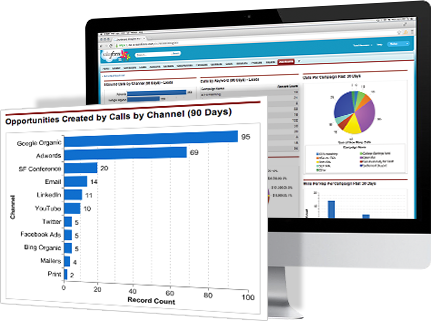
As marketers, we talk a lot about generating leads and driving ROI. However, revenue follows when customers receive the right messages across every touch point. Tracking the impact of marketing campaigns on inbound call activity in Salesforce.com is a powerful way for marketers to determine which campaigns create valuable customer relationships. This, along with tracking tradition metrics, allows marketers to invest more in the campaigns that offer the best returns.
Understanding call metrics can help every company answer Salesforce.com’s Questions to Becoming a Customer Company
The Power of the Marketing Cloud
Like our customers, we use Salesforce.com daily to manage our relationships. As someone with first-hand experience working as a sales rep and marketer in organizations without a CRM, I know how much easier it is to offer customers a great experience when you can see their purchase and contact history in Salesforce. It sure beats scrambling for customer data in email inboxes, spreadsheets, and, yes, on scraps of notebook paper. With several acquisitions, Salesforce is now giving marketers a reason to rejoice, offering robust marketing automation and social media marketing functionality. We’re impressed with what Salesforce has assembled, and Revenue.io gives marketers one more reason to make Salesforce the center of the marketing analysis engine.
The Benefits of Tracking Phone Call Conversions in Salesforce.com
Phone call conversion tracking in Salesforce.com can quickly give marketers key metrics that can help them maximize the impact of their marketing budget. By tracking call metrics in Salesforce.com, marketers can:
- Know which efforts and keywords drive successful calls.
- Get credit for every lead, opportunity, and dollar of revenue closed over the phone.
- Share marketing data with sales reps in real-time so that reps will instantly know what to sell inbound prospects based on the marketing promotion, keyword, or URL that caused them to call.
- Gain real-time feedback from sales reps into lead quality — Revenue.io enables sales reps to rate every call and instantly log those ratings in Salesforce.
Track Call Conversions & Become a Customer Company
Over the last year, Revenue.io has evolved into a robust communications platform with solutions for marketing and inside sales. Initially, we simply wanted to create an app that enables marketers to track conversions and ROI from calls on Salesforce.com. By using Revenue.io, marketers can track call conversion metrics in Salesforce.com automatically. If you’ve already invested in Salesforce, there’s no need to purchase software that makes guesses at call conversions based on vocal inflection. You can simply see, in real-time, which marketing campaigns drive leads, opportunities, and revenue over the phone. This enables marketers to make smarter investments and pivot messaging based on facts, not speculation.
As we gear up for this year’s Dreamforce, we’re excited about Salesforce’s theme of being a “customer company” because it aligns with our philosophy. When customers pick up their phones to call your business, it’s a moment of truth. There are few greater demonstrations of demand. That’s why knowing which messages are causing the right leads to call is vital. That’s why it is so important to track call conversions. By using Revenue.io to track phone call metrics in Salesforce.com, marketers can invest in efforts with messages that resonate with customers.
Why Marketers Use Salesforce for Call Tracking
More marketers are leading inbound sales teams, but even if your inbound sales team doesn’t report directly to Marketing, marketers still have the power and—in my opinion— the responsibility to help sales reps succeed. And one of the best ways to enable sales is by using a call tracking system. Call tracking software is routinely used by marketers to see the impact of their efforts on inbound calls. Call tracking tools can help marketers do a better job of investing in the campaigns and keywords that drive the best calls.
And by using a call tracking tool that integrates with Salesforce, marketers not only gain the ability to see which efforts drive calls that result in opportunities and revenue, but they can also share call tracking data with inbound sales reps in real time. The result is that sales reps can do a far better job of qualifying and converting inbound phone leads.
Are you thinking about trying a call-tracking solution? Here are some important reasons why our customers are waking up to the benefits of call tracking for marketers and salespeople alike.
Inbound Calls are On the Rise
I remember hearing talk a few years ago that the death of the business phone was imminent. But the opposite turned out to be true. According to BIA Kelsey, businesses spend 64.6 billion a year just to generate inbound calls! BIA/Kelsey also reports that inbound calls driven by mobile search alone are growing at a 42% compound annual growth rate! So if you haven’t already notice an upsurge in calls, you’re probably about to.
With increasing inbound call volume, it becomes more important than ever to be able to know, in real time, which campaigns are driving the best calls. Having access to real-time call tracking dashboards in Salesforce can enable you to see which efforts are driving calls that turn into opportunities and revenue. You can therefore do a far better job of investing in the right efforts.
Phone Leads Rule!
The same report from BIA/Kelsey also reveals that 66.4% of companies surveyed report calls as a high-quality lead source—higher than any other. I recently took some inbound sales calls and I have to say, the phone leads were fantastic. Sure, during your lead qualification process, you may find some phone leads to be unsuitable for one reason or another. But if you’re doing your inbound marketing correctly, most phone leads have already researched your offering and are reaching out to have a serious sales conversation. Think about it, most people don’t call sales reps for fun. When was the last time you called a sales rep and weren’t seriously considering purchasing? With a call tracking solution you can make every advertising dollar count in order to generate as many of those high-value inbound phone leads as possible!
Call Tracking Can Help Sales Reps Close More Revenue
One of my favorite things about using a call tracking system is that call tracking data not only helps me make smarter investments as a marketer, but it also can be used to influence the outcome of calls.
Our call-tracking solution integrates with an intelligent call-routing engine that automatically sends callers to the perfect specialist based on the campaign that triggered the call. For example, say you sell web hosting packages for enterprise clients and SMBs. Ads that are directed at enterprise clients could automatically route to a rep or queue of reps that specialize in selling your enterprise product. Then, that referral source data can be used to trigger a CTI screen pop that provides reps with smart talking points, contact history, and other valuable contextual details. The result is that reps can do a far better job of converting inbound callers into customers. And with our call tracking system, you’ll gain a real-time view of call outcomes in Salesforce.
How to Integrate Call Tracking with Salesforce
Integrating call tracking with Salesforce is easier than you might think, and the benefits are immediate. Most call-tracking solutions offer built-in Salesforce integrations that allow data from inbound calls to be automatically synced with your CRM. To get started, configure your call tracking system to pass key metrics—such as campaign source, keywords, and caller intent—into Salesforce fields.
With this data, Salesforce can generate real-time dashboards and reports, offering visibility into which campaigns drive the most valuable calls. Additionally, when integrated properly, call tracking can trigger automation workflows in Salesforce, such as assigning leads to the appropriate reps, updating contact records, or scheduling follow-up tasks. Seamless integration assures that your sales and marketing teams are aligned and can act quickly on valuable insights.
Best Practices for Sales Call Tracking
To get the most value from sales call tracking, teams need to go beyond basic attribution and use call data to actively improve performance.
1. Track Calls at the Campaign and Keyword Level
Assign unique phone numbers to campaigns, ad groups, and keywords to understand exactly what drives inbound calls. This level of detail allows you to double down on high-performing channels and eliminate wasted spend.
2. Integrate Call Data Directly into Salesforce
Ensure every call is automatically logged in Salesforce with full context, including source, campaign, and call outcome. This gives sales and marketing a shared view of performance and ties conversations directly to pipeline and revenue.
3. Route Calls Based on Intent and Context
Use call tracking data to route inbound calls to the right reps based on what the prospect is interested in. Matching buyers with the right rep improves conversation quality and increases conversion rates.
4. Analyze Call Performance, Not Just Volume
Tracking calls is only the first step. Review conversations to understand what drives successful outcomes, including messaging, objections, and buying signals. Use these insights to improve scripts, coaching, and overall sales execution.
5. Align Sales and Marketing Around Call Data
Use call tracking insights to connect marketing efforts directly to sales outcomes. This helps both teams understand which campaigns generate the highest-quality conversations and where to focus resources.
6. Automate Follow-Ups and Workflows
Trigger automated actions after calls, such as follow-up emails, text messages, or task creation in Salesforce. This ensures no opportunity falls through the cracks and keeps deals moving forward.
7. Focus on Revenue, Not Just Activity
The goal of call tracking is not just to increase the number of calls, but to increase the number of high-quality conversations that convert. Prioritize insights and optimizations that directly impact pipeline and closed revenue.
Marketing Call Tracking vs. Sales Call Tracking
While both marketing and sales call tracking focus on understanding phone conversations, they serve different purposes across the revenue funnel.
Marketing Call Tracking
Marketing call tracking focuses on attribution and demand generation. It helps teams understand what drives inbound calls in the first place.
With marketing call tracking, teams can:
-
Identify which campaigns, ads, or keywords generate calls
-
Measure ROI across paid and organic channels
-
Attribute inbound calls to specific touchpoints
-
Optimize marketing spend based on call volume and quality
Primary goal: Generate more high-intent calls
Sales Call Tracking
Sales call tracking focuses on conversation quality and revenue outcomes. It helps teams understand what happens during calls and how those conversations impact pipeline.
With sales call tracking, teams can:
-
Analyze call performance and conversion rates
-
Identify winning talk tracks and objection handling
-
Improve rep performance through coaching and insights
-
Connect conversations directly to pipeline and closed deals
Primary goal: Convert more calls into revenue
How to Implement Sales Call Tracking in Salesforce
Setting up sales call tracking in Salesforce allows your team to connect every conversation to pipeline and revenue. The key is to ensure both attribution and conversation data are captured and usable.
1. Define What You Want to Track
Start by identifying the key data points you need from every call, such as source, campaign, keyword, and call outcome. This ensures your tracking setup aligns with both marketing and sales goals.
2. Assign Trackable Phone Numbers
Use dynamic or static number assignment to tie phone numbers to specific campaigns, channels, or touchpoints. This allows you to accurately attribute each inbound call to its origin.
3. Integrate Call Tracking with Salesforce
Ensure all call data is automatically logged in Salesforce, including caller details, source, timestamps, and outcomes. This creates a single source of truth for both sales and marketing teams.
4. Set Up Intelligent Call Routing
Route calls based on intent, campaign source, or rep expertise. This ensures prospects are connected to the right person from the start, improving conversation quality and conversion rates.
5. Capture and Analyze Conversations
Record and review calls to understand what drives successful outcomes. Look for patterns in messaging, objections, and buyer signals to improve performance across the team.
6. Automate Follow-Ups and Workflows
Trigger actions after each call, such as creating tasks, sending follow-up emails, or updating deal stages. This keeps opportunities moving and reduces manual work for reps.
7. Optimize Based on Revenue Impact
Use call tracking data to identify which campaigns, reps, and conversations generate the most pipeline and closed deals. Focus your efforts on what drives real revenue, not just activity.
Turn Call Data Into Revenue
Track, route, and optimize every sales call with Revenue.io to increase conversions and drive more pipeline.